Creative Confidence

In, Creative Confidence, Tom Kelley and David Kelley talk about creativity and how effective design thinking can be in traditionally non-creative fields. Here are some excerpts I enjoyed.

In our experience, one of the scariest snakes in the room is the fear of failure, which manifests itself in such ways as fear of being judged, fear of getting started, fear of the unknown. And while much has been said about fear of failure, it still is the single biggest obstacle people face to creative success.

I used to listen to the Dave Dameshek podcast a lot. One of his catchphrases and audio drops was “When I’m wrong, I say I’m wrong.” My brother and I used to have incredible trouble saying we were wrong. Then one day it changed. I decided to make an effort to identify when I’m about to argue about something for the sake of not being wrong (when I know I’m wrong).

Being afraid of failure is similar. Sometimes it prevents people from starting in the first place. Or from admitting failure and fighting too long to save a sinking ship.

With prototypes, you go in with failure in mind. You test a prototype and see where things failed. The key is failing at a planned time and knowing there’s a chance to learn and fix it before it really counts.

The question hung in the air for a moment before Yo-Yo Ma delivered the bad news to Erik. Long after ascending to the top of his field, Yo-Yo Ma continues to practice as much as six hours a day.

DJ Q-Bert was a hero of mine in middle school, because I liked the idea of being a DJ. I saved up for turntables and then sort of expected to be a DJ, but I didn’t understand that it would take practice. DJ Q-Bert has been world class in his art.

One day hanging out with friends, a waitress let us know that some DJ was performing a set across the street at Turntable Lab. We went across the street and there he was, DJ Q-Bert. Someone asked what he did to practice. Did? I still practice every day.

Karaoke confidence, like creative confidence, depends on an absence of fear of failure and judgment.

There should be a book about Karaoke confidence. I’ve been part of my fair share of Karaoke nights. K-Town has a lot of places where you can book smaller rooms with friends to sing you heart out. Fear of failure and judgment can’t get past those doors. This is where you work out the moves. It’s the paper prototype.

There are other Karaoke places. The ones without rooms. The places where you sing in front of the entire bar. While people play pool and your goal is to at least have them look up. It’s the beta.

The analogy falls apart here. You can prototype things and then eventually release something to the real world based on iterations of that prototype. Professional singers probably don’t get their reps in various Karaoke lounges.

“Think of today as a prototype. What would you change?”

I thought this was great. I’m a designer in tech, so prototypes are a known concept to people I work with. After reading Creative Confidence, I started noticing prototypes and iteration in other fields. Even if they’re not calling it prototyping. Storyboards for filmmakers. Test kitchens and soft openings for chefs. Open mics for stand-up comedians. Situational drills for sports. Labbing in virtual sports like Madden. The list goes on and on.

Writing isn't: Those other things

This is the third part of a series of posts about trying to publish daily. Check out the intro. For the first section of the series, I’m writing about things that aren’t exactly sitting down and adding words to something.

These things aren’t putting words to paper at all — but they’re probably more important.

Thinking about what to write

In the intro to this series of posts, I mentioned Gladwell saying that writing is the blissful part. And it isn’t the bulk of it.

For every hour I spend writing, I spend three hours thinking about what I’m writing.

It’s safe to say Malcolm Gladwell is more thoughtful about his writing than I am. But we already knew that. Still, I spend time thinking about what to write. Right now, that means thinking about writing about writing. He discusses his time at the Washington Post and Tim Ferriss mentions that journalists are different beasts. Gladwell says he doesn’t really have writer’s block (“working at a newspaper cures you quickly”).

All the thinking means that he can sit down to organized blanks left to fill in:

I know what I’m doing before I start.

I don’t know what I’m doing even after I end.

Reading about writing

It feels so productive. I get motivated hearing other writers say that they don’t wait to feel motivated.

I’ve been reading about writing. I’m not the first person (or millionth) trying to increase the amount of writing I produce. I’ve read books pretty specifically about increasing daily word counts. I’m not trying to reach a specific word count. Doing things like dictating gives me a nearly impossible block of words to edit. I think it might be worth practicing.

I’ve been reading about establishing writing habits. They partly overlap with general productivity books. I’ve read a lot of those. They’re useful for this current project, because I am establishing a habit of publishing daily. There’s usually a really good tip or two.

I’ve read books about improving writing quality. I’ll continue finding and reading them. More importantly, I need to deliberately practice1 writing.

Listening to things about writing

Podcasts make it possible to listen to multiple interviews with people I admire. A lot of them are writers. Many writers are happy to share their knowledge. Hearing about their morning routines is helpful. Both for inspiration and for thinking about how to apply their experience to my own process.

They rarely talk about the words themselves. Yes, it’s something that’s not writing which helps me improve in things that are also not writing. But that will help me as a writer. Please don’t take this paragraph as evidence.

Tinkering

I know how to make websites. I’ve programmed for a living. I design web apps for a living. I have a handle on what’s under the hood of this blog. So I’m tempted to tinker. If something doesn’t look right, I want to fix it immediately. That means opening a black hole of code and losing somewhere between 5 minutes and 5 hours2.

Maybe it’s like trying to be a writer in 1930 who’s also a typewriter technician and who happens to know how to adjust the printing press. The distraction isn’t quite as romantic as these old world tools, but the solution is the same: sit down and write. And stay away from those tools.

  1. After typing these words, I looked up a bunch of links about deliberate practice and writing. Hey, that sounds like a post idea.

  2. I usually set a timer when writing, but It’d be good to set a timer if I’m about to tinker. Time can fly when changing HTML/CSS or writing shell scripts trying to automate things. It can be rewarding, but sometimes it isn’t worth the lost time.

Bird By Bird

Bird by Bird is one of my favorite books about the value of writing regularly. Anne Lamott weaves stories of her life with writing advice. Here are some of my favorite excerpts.

She said that sometimes she uses a formula when writing a short story, which goes ABDCE, for Action, Background, Development, Climax, and Ending.

More thoughts on structure. That’s a pretty easy to remember sequence. Can this formula work for writing an article? A lot of nonfiction books are collections of short narratives.

Maybe I can practice this sequence with that formula.

Action: Me writing furiously in various Dunkin Donuts through three months.

Background: Why am I trying to write? Why three months? Why Dunkin Donuts?

Development: Then I learn through repetition (aka hearing it on various podcasts) that writing is really in the thinking and organization.

Climax: Me thinking furiously in various Dunkin Donuts.

Ending: Glory. Riches. A few new Medium followers. And a realization that all three of these are the same things.

Perfectionism is a mean, frozen form of idealism, while messes are the artist’s true friend.

Once you accept that perfection isn’t necessary, you’ll start shipping. I’m not sure about the idea that you should ship while you’re still embarrassed. It’s good to apply to an entire product that you’ll iterate on. But it’s not like each of these posts will be read multiple times by individuals. I’ve got one shot in a lot of cases.

That said, I’ve been posting plenty of things that I’m embarrassed about looking back. But I listened to a podcast with Seth Godin and they talk about people who look at things and are embarrassed when looking back and those that are happy with it and don’t dwell.

If I didn’t write something for fear that I’d look back on it and shake my head at how bad it is, I wouldn’t write at all.

Writing has so much to give, so much to teach, so many surprises. That thing you had to force yourself to do—the actual act of writing—turns out to be the best part. It’s like discovering that while you thought you needed the tea ceremony for the caffeine, what you really needed was the tea ceremony. The act of writing turns out to be its own reward.

I’m experiencing this right now. After getting over the initial inertia, thinking through different systems, setting those systems up, struggling to learn the proper length to aim for in a day, and plenty of other hiccups, it’s starting to be very rewarding.

I used to look forward to the coffee in the morning. Queue. Action. Reward. Now I look forward to the writing. It’s become the reward.

(I still like the coffee too.)

“Do it every day for a while,” my father kept saying. “Do it as you would do scales on the piano. Do it by prearrangement with yourself. Do it as a debt of honor. And make a commitment to finishing things.”

I’ve been doing this every day. I don’t think it qualifies for “a while” yet. I don’t know yet what would be the writing equivalent of scales. Maybe writing a page under the same template each day. It is a prearrangement with myself. It does feel rewarding to honor a commitment I made to myself. And I’m appreciating the feeling of finishing. With each post and eventually with the collective whole of 100 posts.

A friend of mine says that the first draft is the down draft—you just get it down. The second draft is the up draft—you fix it up. You try to say what you have to say more accurately. And the third draft is the dental draft, where you check every tooth, to see if it’s loose or cramped or decayed, or even, God help us, healthy.

I’m too slow to get to the down draft and too often that’s as far as I get. Hopefully focusing on writing one thing each day will encourage me to get to the up draft and then the third draft.

I went to the dentist this week. It’s been six years and luckily1 I had no cavities. There was a portion where I had no idea what was going on but the dentist would poke around and call out numbers. I asked and they were checking the separation between the tooth and gum based on how deep the instrument could go in. Anyway, each check was a little painful but sometimes it’s good to do that thorough check to find out where things might be breaking down.

There’s some other design or career analogy here. Oh yeah it’s about upkeep. Dental hygiene is made up of daily routines. You can’t floss for an hour at the end of the month to make up for things. You can ignore your daily routine then go to the dentist and get cavities filled, but it’s not the same as if you were just following the proper routine daily.


  1. Note for the up draft: miraculously might be the better word here. ↩︎

Writing isn't: Publishing

This is the first part of a series of posts about trying to publish daily. Check out the intro. For the first section of the series, I’m writing about things that aren’t exactly sitting down and adding words to something.

These are the things I don’t set time aside to do. They’re usually what’s left when I have a bunch of unfinished posts. They’re the things I can’t do completely offline so I’m most prone to distraction here.

Adding excerpts

Excerpts usually come from books or, lately, podcasts. For books, the best way for me to search is using the Kindle app on my MacBook. It’s still a little rough because I might not remember the exact wording so searching doesn’t work. If it’s highlighted then I can scroll through them and find it. Also a little clunky. I almost only read eBooks these days but it’s still not great trying to shuffle through the book.

Finding an excerpt in a podcast can be even more frustrating. I’m trying to be more diligent about bookmarking podcasts and adding notes1. I set fast forward to skip 30 seconds (for jumping through ads) and rewind goes 10 seconds back (to bookmark properly).

Sometimes I’ll hear something I’d want to write thoughts on later and skip bookmarking. I’ll be convinced that I can remember the general section it was in. But people can say so much, so quickly. You can skim a page and know if the phrase is on it after a few seconds. In the same amount of time, you can listen to maybe two sentences. It’d be great to comprehend audio at 10x.

And then there’s transcribing. I try to write it down as accurately as I can. I’m always surprised how many words are missing or just completely wrong after one pass. Because I’m focusing and trying pretty hard. “Has a gym” might become “runs a gym” because the previous sentence mentioned running.

Adding images

I usually try to use my own photos, which means I’ll do some editing. Actually, in any case I’m usually editing the photo in some way. And of all the things in this post, editing photos is the furthest away from actually writing. I like my Docs to Jekyll workflow right now, but images make things clunky2.

Right now, I’m pretty happy with the setup, but it took a while. Here’s what I do:

  • Browse through my pictures in Google Photos

  • Edit in Google Photos: Usually just Auto and then Resize with 16:9

  • Save from Google Photos to a local directory

    • This is where some magic3 happens to get it onto my server
  • Add to my post in Google Docs using TextExpander to do the Markdown markup

As for animated GIFs:

  • Go to YouTube to find a relevant video

  • Use LICEcap to record a few seconds of it

  • Use Photoshop to resize and make the quality awful so the filesize goes down

This takes anywhere from 3 minutes to 3 hours depending on how lost in YouTube I get.

It’s weird, links can be like super footnotes, adding tons of context. You send someone away and risk that they’ll never come back. The risk when writing is similar. I’m trying to find a link to something interesting. That site might also have other things I find interesting. Or I’m just linking to a GIF, but I want to find the perfect one. And then it’s thirty minutes later. I’m learning it’s helpful to batch these things or do them as I go along:

  • Book excerpts: I add a note to my Kindle highlight if I know I’ll write about it later. Highlights with notes are easier to find and I can write a sentence about what I was thinking.

  • Podcast excerpts: I’ve been bookmarking more and, similar to Kindle highlights, I add a note.

  • Images: I’ve been using Google Photos for editing and pasting straight to the document. I also add pictures I want to use into an album strictly for adding to posts.

  • Links: I’ve been using the *research feature in Google Docs *to add links. You can highlight a phrase in your document and press cmd+ctrl+shift+i and it’ll do a web search for the phrase. You can click “insert link” from the results page and you’re set. This keeps me from actually going to the site.

Whatever it takes to stay in a text editor. You know, writing.

  1. Thank you Instacast. I’ll pour one out for you.

  2. Possibly a blessing in disguise, because my goal with this project is to improve as a writer, not a photographer.

  3. Magic: A set of scripts and Hazel rules tenuously tied together that resizes and moves things from directories to mounted directories. If I breathe too hard, this breaks.

Writing isn't: Sort of writing

This is the first part of a series of posts about trying to publish daily. Check out the intro. For the first section of the series, I’m writing about things that aren’t exactly sitting down and adding words to something.

We moved a lot when I was a kid1. Even after moving to a different base, we would still move a few times within that stay. When first arriving, we stayed for a few weeks at a Navy Lodge until we found a house off base. We would stay at that house off base for a few months until we got to the top of the waiting list for a house on base.

These things aren’t quite sitting there churning out words. I consider these sort of like writing because things are moving out of your head to a paper or a screen.

Outlining

I love outlining. It’s important to have something to follow to avoid thinking about what to write. Just fill in the blanks. Words are going down and you can feel like celebrating something incomplete. When trying to publish daily, though, it’s easy to outline without thinking about how long it will take to fill those blanks in. The time block ends and the outline does history’s mildest Mr. Hyde impression, transforming from an encouraging tree of ideas to an unfinished todo list2.

Playing with post-its (The Board)

This series of posts on writing is my first experiment with “The Board”3, a tool Blake Snyder explains in Save the Cat:

The Board is a way for you to “see” your movie before you start writing. It is a way to easily test different scenes, story arcs, ideas, bits of dialogue and story rhythms, and decide whether they work — or if they just plain suck.

He’s right, it is fun. It’s offline. I love moving post-its around4. It’s good to have structure to follow and, again, fill in the blanks. It really is another form of outlining, except it has a little more spatial awareness. And there’s less temptation to start writing anything of length5, because you can’t fit much on a post-it note.

Blake Snyder describes the board as a waste of time, knowing it can be a distraction. He’s half joking and explains that the board is a good distraction: you need time away from your writing for thoughts to brew.

Editing

To write anything good, editing becomes more important than getting the first draft down. But you can skip revising and still have something to publish. I set time aside each day to write but I still don’t set aside enough time to revise and finish posts. Revising and editing will help me get from writing bad posts to writing posts that aren’t bad6. Then comes trial and error to figure out what animal to sacrifice7 to get to good.

Someday I’ll have darlings to kill. In the meantime I’ll take be taking these garbage bags out back. My first form is a trash compactor. A programmer considers deleting a bunch of code a good day. It signals they’ve found a better way to do something8. Finding a precise word to replace four probably gives writers the same pleasure.

And on and on

I moved a lot as an adult. After moving to New York, I stayed for a couple nights at a friend’s place. Then a few days at an Airbnb, and another Airbnb. Then I moved to a one-month sublet. Then to another one-month sublet. Then to a nine-month sublet. And then to my current apartment, where I’m likely to renew for a 4th year. Things feel pretty good here.

Words and thoughts move more easily at the start9.

  1. I can’t assume anyone reading any one post will know anything about me, so I’m probably going to repeat this often.

  2. I guess most todo lists are unfinished.

  3. My girlfriend asked if people think others would think the board is weird. I’m at The Bean right now where I’ve seen people jamming on Korg controllers. High bar for weirdness here.

  4. UX designers do this to get good shots for their portfolios. Now I’m half joking.

  5. Outlining in Google Docs usually ends up being half outlining and half writing. No half measures

  6. Or going from two crappy pages to half of a decent page.

  7. Watch out for my book notes on The Lean Sacrifice in 2019.

  8. There’s gotta be some kind of articles talking about writing and programming and the similarities.

  9. I like the metaphor and can’t wait for the day that I can write about it elegantly. I’ll try again in a few months and hopefully again in a few years.

Save the Cat

These are book notes for Save the Cat, by Blake Snyder. I paused about 30 pages in on my first read, about a year ago. I was reading Nobody Wants to Read Your Shi* recently, and Steven Pressfield mentions Save the Cat as a great resource. I picked it back up and finished it this time around. Here are some excerpts I enjoyed.

The number one thing a good logline must have, the single most important element, is: irony.

Save the Cat stresses the importance of loglines. Nobody Wants to Read Your Shi* talks about concepts in ad campaigns. Good concepts lead to lots of good ad copy that works as a hole. A logline helps keep a movie anchored.

Now that the posts are adding up, I’m thinking about the bigger picture of this 100 days, 100 posts project. What’s my logline? Considering irony is important. Maybe that stacking two crappy pages each day leads to something valuable. But you need to believe.

Hopefully I have a better logline when I’m 100 days in. Though that’s working backwards.

Because liking the person we go on a journey with is the single most important element in drawing us into the story.

He describes Lara Croft as “cold and humorless” in the movie version of Tomb Raider. On the other hand, we’d probably be happy following Mark Watney on any journey he decides to take. As far as writing goes, maybe I need to start thinking about being likable. That didn’t work in 7th grade… but it might work this time.

The theme of every Golden Fleece movie is internal growth; how the incidents affect the hero is, in fact, the plot.

One of the best things in the book is the different nicknames for concepts. Maybe I can do a small sketch for five different concepts in the book. Save the Cat (make your main character likable), etc.

Now look at The Matrix and compare and contrast it with the Disney/Pixar hit Monsters, Inc. Yup. Same movie.

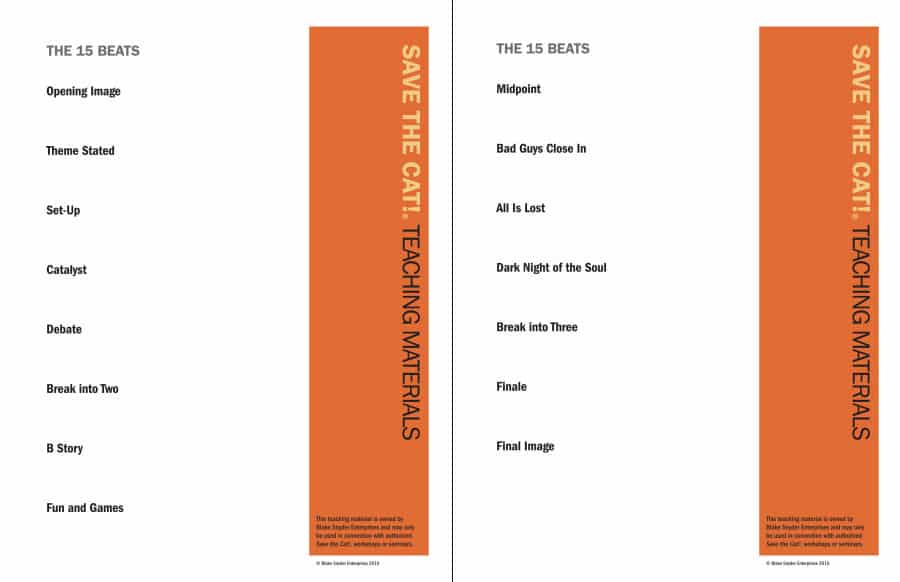
The most immediately applicable part of the book is Blake Snyder’s 15-step beat sheet. As far as 80/20 goes, the beat sheet is the crucial 20% of Save the Cat. Snyder points out how different movies apply these beats. Some more than others, but they’re there if you keep an eye out.

A team updates the Save the Cat website, and I was happy to see that their beat sheet list is still updated. Here are a few of my favorites:

Pick some movies you like and check the beat sheet out for an idea of how all the concepts can be found in different movies.

“This sure isn’t like the time I was the star fullback for the N.Y. Giants until my… accident.”

That’s one of Blake’s examples of bad dialogue you want to avoid writing. As far as things I want to pursue: I’d like to write how Blake Snyder writes. Save the Cat ‘s fun to read. Plenty of people disagree with that, and I imagine they’re out writing very sophisticated screenplays. Doing a little bit of searching, I’ve learned that it’s a polarizing book. And people will go as far as saying it’s ruined movies in the past few years1.

Blake Snyder passed away in 2009. It would’ve been great to hear what he thinks about the industry today and if any of the tips would change (I doubt it). He comes across really encouraging in his writing:

Would you blanch if I told you it was just a matter of turning the crank again and again until something happens? Because that’s all it takes. Just keep turning the crank. Any inroad, any one at all, is a gigantic leap forward.

Screenplays tell stories in fewer words than novels. They have to. The rules are set. You can self-publish a 1200 page behemoth at your leisure, but (for all intents and purposes) you can’t quite self-produce your 250 page screenplay.

Hollywood is filled with storytellers, and successful nonfiction writers know how to tell interesting, concise stories. I can learn a lot about applying these lessons, even if I’m not writing a screenplay. I’ll read his other two books later this year—maybe before this 100 days, 100 posts project ends.

In the meantime, I’ll be thinking about structure and storytelling2 in my future posts.

  1. Though if Hollywood really was making films based on Save the Cat, well, that sounds like a ringing endorsement for the book. A portion of the book focuses on how to get your screenplay noticed. The book operates under the notion that selling your screenplay is the goal. Nobody remembers an unproduced screenplay for its literary merits. It’s either made into a movie or it’s not.
  2. Peter Suderman wrote that Slate article about Save the Cat following Save the Cat’s beat sheet.

On Writing Well

These are book notes for On Writing Well, by William Zinsser.

But the secret of good writing is to strip every sentence to its cleanest components.

Good writing comes in the editing. I need to set time aside to deliberately practice cutting sentences down. In a past technical writing internship, I learned the importance of simple sentences. If people are following directions, extra words distract.

One assignment that’s stuck with me comes from a software documentation class1. It was probably the first or second assignment. We were supposed to write directions for something we’re familiar with, like making a peanut butter and jelly sandwich. (Or maybe the entire class had to write steps for making a peanut butter and jelly sandwich.)

The next day, the teacher brought in the usual things for making PB&Js. He then took a random sheet from the stack and tried to follow the directions, of course following it word for word. Always failing. He demonstrated how you can cause confusion with too many words and too few.

Writers must therefore constantly ask: what am I trying to say? Surprisingly often they don’t know.

Asking this for every paragraph is good practice when outlining and writing a first draft.. Asking this for every sentence will help in editing and creating the second and third drafts. Asking this for every word is probably what separates good writers from the rest. Knowing the right answer separates the great.

What am I trying to say in this post? On Writing Well is a great book about improving as a writer.

I’m currently reading Save the Cat and Nobody wants to read your shi*. Both of them talk about underlying concepts in writing.

Zooming back, what am I trying to say in these 100 posts? Consistently working on something a little bit at a time (two pages a day) adds up.

Good writing has an aliveness that keeps the reader reading from one paragraph to the next, and it’s not a question of gimmicks to “personalize” the author. It’s a question of using the English language in a way that will achieve the greatest clarity and strength.

I’m currently using a gimmick in footnotes, but I think the footnotes are where I write things that are most alive. Maybe because they’re typically more personal thoughts. Somehow I need to bring that aliveness to the relevant points.

My vocabulary is okay. There’s a little bit of conflict there, because I want to expand the vocabulary of words I use. But then that gets away from the idea of writing how you speak. That’s the kind of writing that I enjoy reading. I mean, I’d probably say “has no bearing on” instead of “inconsequential”. I guess knowing which one to use when will come with experience.

Ultimately the product that any writer has to sell is not the subject being written about, but who he or she is.

This is getting pretty deep. I’ve never thought of selling myself as a writer. Well, I guess I’ve thought it’d be cool to earn money through writing. And I know he didn’t really mean “sell” in monetary terms. More just making people believe in a subject. And in turn, making them believe in me as a writer. This just got deeper.

Something from earlier is stuck in my head: my footnotes have the most aliveness. I’ll continue trying to figure that out. I think it’s because the footnotes give a sense of who I am.

One underlying goal when writing documentation is writing in a way where you can hide the seams between people. It’s written like code. You shouldn’t be able to tell who wrote it. If I want to succeed in any way as a writer, I need to start shooting for the opposite.

Clear thinking becomes clear writing; one can’t exist without the other.

Malcolm Gladwell estimates that finishing a book is probably 25% writing and 75% thinking about the writing. And it’s a cycle: learning to write clearly becomes learning to think clearly. That’s why you have to get the reps in. That’s why I’m trying to publish daily.

  1. Did you fall asleep just imagining this course?

59 Seconds

These are book notes for 59 Seconds by Richard Wiseman.

“He that has once done you a kindness will be more ready to do you another than he whom you yourself have obliged.” In other words, to increase the likelihood that someone will like you, get that person to do you a favor.

The quote in the excerpt is from Benjamin Franklin. Something I really like from Derek Sivers is his idea of “directives”. He reads a lot and sometimes his friends really just want a “Just tell me what to do” summary. 59 Seconds gives a “Just tell me what to do” summary of research. It gives practical, straightforward advice for many aspects of life.

In short, when it comes to an instant fix for everyday happiness, certain types of writing have a surprisingly quick and large impact. Expressing gratitude, thinking about a perfect future, and affectionate writing have been scientifically proven to work—and all they require is a pen, a piece of paper, and a few moments of your time.

I’ve written daily in the past, but I haven’t tried publishing daily. When wrote daily I would try to write gratitudes and affirmations. It was a very successful period in my life. So I believe they work. 59 Seconds presents the science of why. I’ve heard Tim Ferriss mention the 5-Minute Journal multiple times.

From a psychological perspective, thinking and writing are very different. Thinking can often be somewhat unstructured, disorganized, and even chaotic. In contrast, writing encourages the creation of a storyline and structure that help people make sense of what has happened and work toward a solution. In short, talking can add to a sense of confusion, but writing provides a more systematic, solution-based approach.

+1 for writing. In On Writing Well, William Zinsser says “clear thinking becomes clear writing”. The other way around, as this excerpt talks about, writing helps clarify thinking. Just another positive aspect of writing and it sure makes all of this seem worth it.

It seems that presenting weaknesses early is seen as a sign of openness.

Humility helps. You want to end on a good note. And you’ll probably want to start on a good note, too. But present weakness closer to the beginning than to the end and it can help paint the rest of what you’re saying in a positive light. It’s always nice to be confident you’re talking to someone who has nothing to hide.

Successful participants broke their overall goal into a series of sub-goals and thereby created a step-by-step process that helped remove the fear and hesitation often associated with trying to achieve a major life change. These plans were especially powerful when the sub-goals were concrete, measurable, and time-based.

Hey, hey. Let’s check these goals out.

Overall goal: Publish 100 posts in 20 weeks. Sub-goals: Publish 5 posts each week.

Zooming in. Overall goal: Publish 5 posts a week. Sub-goals: Publish each day with a 2-day buffer each week for planning and life.

Zooming out. Overall goal: Improve as a writer and increase comfort with sharing my writing. Sub-goal: Publish 100 posts in 20 weeks.

Friday Links Issue 03

Here’s a set of four links from the week. When I started this 100 posts in 100 days project, I knew I’d need some recurring posts to fill in some blanks. These link collections are supposed to be straightforward to write. Attacking my fear of using ‘ironically’ incorrectly head-on, they ironically take longer to write than other posts from the week. Here we go.

Stephen King & George R.R. Martin

I want to write something longer about this conversation between Stephen King and George R.R. Martin, but I thought it’d be good to write something now while it’s completely fresh in my memory. They take turns asking each other questions for an hour. Nearly all questions are answered with a great story from each author.

Martin: How do you write so many books?

King: When I’m working I do six pages a day.

Martin: And you usually hit six pages a day?

King: I do.

I admire them both even though I haven’t read a lot of their work. I love On Writing. Recently I read A Knight of Seven Kingdoms. It’s excellent, and now I have a sense of why the A Song of Ice and Fire series is so popular with readers. (Beyond the sense I got from being a loyal Game of Thrones viewer/wiki reader.)

Cal Newport: Monday Master Class (2008)

In this article, Cal Newport lays out actionable steps to taking the time to think and organize thoughts before a single key is pressed.

You type a little. You add a quote that makes sense. You glance at that little page count number in the lower left corner. You type a little more. Eventually you hit your magic page count. A couple quick editing passes and you’re done!

Basically my current writing process. Lately I’ve been thinking about things that go into writing that aren’t writing. Typing is the easy part. Similar to Gladwell saying most of the time spent writing a book is in thinking and organizing. At the start of this project, I’ve been focusing on the typing part, and I think that’s fine. I’ll slowly shift to thinking more deeply about subjects, but establishing the writing habit is important to me right now. Maybe I’ll try a few walks home from work without a podcast or audiobook, just trying to organize thoughts to write about. Then I can dive into transferring those thoughts to different boards when I’m home. Anything I can do to stay away from a text editor.

In the morning, I’ll wake up and fill in the blanks. It will be blissful.

How’s that for an affirmation1?

Ten thousand, one thousand, but first, ten

Maybe these Friday Five posts can be summaries of future posts that I’ll expand on. This week, I’ve run into a few links about the number of people looking at your work and how important they are.

I’d love to further compare and contrast the concepts behind these messages. Maybe that will help me find my first ten.

Five in my Four

Bonus content that nobody was asking for. Again, this weekly post is inspired by Tim Ferriss and his 5-Bullet Friday newsletter.

Person I’m enjoying following

This week I’ve been going back through Cal Newport’s books and his blog. There’s a lot of posts about writing, though they’re about writing term papers. A lot of it seems applicable to the types of things I want to write.

When I lay it out, it’s not exactly the next great American novel: I want to write blog posts with links. But I want them to be good. I want to practice organizing thoughts into narratives.

After all, I found Cal’s blog post interesting enough to write about and share 8 years after it was originally posted. And 8 years later, he’s still publishing books and churning out interesting blog posts. Cal doesn’t use social media, but I’ll continue trying to follow his example.

Purchase I’m loving

Amazon has a white Kindle again. It looks great in person (that picture is my girlfriend’s). I also started using a big sketchbook with post-its to have a portable board. It’s a good size for planning posts.

Oh yeah, I also picked up a bunch of Muji storyboard books on my trip to Tokyo. I’m still sad they discontinued them in America. There’s a scene from Silicon Valley showing fake accounts being made in a computer farm. Can I pay them to send Muji emails requesting the return of the storyboard book? “It took me all day, but I got the ten signatures I needed.” — George Michael Bluth

What I’m listening to

I’ve been listening to a lot of random “mozart piano” results on Spotify. Just to have something on when I’m writing or reading. I used to use Focus@Will, but I can’t if I’m on the subway. By view count, my most successful writing was about design. A good portion of it was written while listening to various sounds coming from Focus@Will. The Spotify + Bit Timer combo has been serviceable lately.

Most popular post on instagram

I only posted one photo on Instagram. I’ll re-post here:

Temple

I’ve been going through photos from recent travel. This one is from Sensoji Temple. Lots of beautiful lanterns. I shot this shortly after receiving a lukewarm fortune. Above is the full crop instead of the 1:1 version I posted to Instagram.

And here’s a bonus picture for the 4th of July weekend.

Quote I’m Pondering

From one of Steven Pressfield’s ad copy mentors in Nobody Wants to Read Your Shi* (currently free to download!):

“Kid, it’s not stealing if you put a spin on it.”

Well, I certainly stole these link headings. I hope everything under the headings is enough of a spin.

  1. Also this has a 2008 Ramit Sethi comment with his updated avatar. Ramit was out there just commenting on blogs. Ramit, just like us!

Trying to publish daily: Writing isn't intro

This is the intro for a series of posts about things I’ve learned while trying to publish daily. I’m experimenting with a board of post-its to organize my writing, inspired by Save the Cat. I intended for this to be the third part of a series of three posts, but I just kept adding post its and now it’s looking like 9 posts.

I’ve been trying to publish1 daily. My goal is to publish 100 posts in 20 weeks. Or was it 100 posts in 100 days. I flip flop between the two depending on how motivated I am meaning how much sleep I had the night before.

These posts about what what writing isn’t should be posts 28, 29, and 30. I wrote about writing when I was ten days in and twenty days in. Now I’m approaching 30 days in. One thing I learned: trying to write a lot leads to thinking about writing a lot which leads to writing about writing a lot. Not ideal, but it’s fine.

Even though I knew it might happen, I still mix up writing daily with publishing daily. Writing daily is straightforward. Open a notebook or doc and put words down. Publishing means the words will be public, so they should be revised to keep people from wasting time, and then there are logistics to it too.

Malcolm Gladwell sums this up:

Writing is not the time consuming part. It’s knowing what to write. It’s the thinking and the arranging and the interviewing and the researching and the organizing. That’s what takes time. Writing is blissful, I wish I could do it more.

I’m starting to understand. Writing and getting into some kind of flow is fun, but there’s a bunch of other stuff that’s part of the process and some that has to do with publishing. I’ll try writing about them here. Lately I’ve been thinking about finishing posts each day, instead of building up a backlog of sort of finished posts.

Here’s an outline of the this section, showing the next three posts I’ll write2 (and a preview of two more sections that I’m hoping will also be three posts each).

  • Section 1: Writing isn’t

    • Part of writing

      • Outlining

      • Playing with post-its (The Board)

      • Editing

    • Part of publishing

      • Adding excerpts

      • Adding links

      • Adding images

    • Not part of anything, but important

      • Thinking about what to write

      • Reading about writing

      • Tinkering

  • Section 2: Focus, Systems, and Routine

  • Section 3: Time, Location, Tools

  1. And daily I wonder if there’s a better word than “publish”, because I think of scientists who get published. It’s means something more than typing ‘jekyll build’ and uploading it somewhere.

  2. Maybe this can be a part of… is there a word for a novella-length non-fiction book? Non-fictionella. Or I guess some are called handbooks.

Design Sprints and The Board

One section in Save The Cat is called “Chairman of the Board” and talks about a screenwriting tool called “The Board”.

Have a great piece of dialogue? Write it on a card and stick it on The Board where you think it might go. Have an idea for a chase sequence? Deal up them cards and take a looksee. And talk about creating a pressure-free zone! No more blank pages. It’s all just little bitty index card-sized pages. And who can’t fill up an index card?

Thinking about a collection of cards sounds pretty close to the cliche UX portfolio image except with index cards instead of post-its. There’s plenty of creativity in UX, but designers follow some kind of process to their work. Design sprints break the design process down into steps that a team can follow to select an idea and prototype the solution to a problem. Each step acts like a function, something goes in and something else comes out based on the input.

  • Understand: Existing knowledge goes in and is appended to everyone’s knowledge

  • Diverge: Knowledge goes in and many ideas come out

  • Decide: Many ideas come in and the best one comes out

  • Prototype: A storyboard goes in and a clickable flow comes out

  • Test: A clickable flow goes in with users and valuable feedback comes out

I’ve participated in design sprints and used it as a process to follow on solo projects. I’ll be thinking about structure and process as I go along. It’d be good to have ideas broken up by how much time I’ll have for the day.

Each post can have one thought. That might be how I need to break things down. I’m going to try creating a board for some posts I’m writing to see how it goes. First, I need to finish reading this chapter.

On writing daily, style, and clarity

I really enjoyed this post by Ryan Holiday: Why do you write so much1? Nobody has ever asked me why I write so much. Maybe that can be a goal. Recently, it’s certainly crossed my mind. “What’s the point.” Sometimes I’ll read things I’ve written recently and I wonder how long it’ll take until it’s worth reading. I believe in the system — just not all the time. Most of the time, though, I do. If I publish2 100 things, I’ll be better than when I started. I think it’s going to start taking some deliberate practice.

One technical communication class sticks out to me. First, it was with one of my favorite teachers from college. Who believed in me enough after I graduated to hire me to build her portfolio site (she was a freelance writer). Anyway, I can’t remember what the class was called. But we did some deliberate practice. Most helpful were exercises about cohesion and coherence in writing.

Up to that point, coherence was stressed in English classes or for writing assignments in other subjects. But in these writing exercises, we would get lists of sentences and analyze how rearranging the sentences could emphasize or confuse points. I really got to see that there are many ways to write the same sentence, but some can be much clearer than others.

Here’s the book: Style: Lessons in Clarity and Grace. For some reason, it’s over $50 new and not available on Kindle. But I found my old copy at my parent’s house and brought it back to New York. I’ll have to take some time to review it. Maybe I can share some examples of good sentences. And eventually create my own.

While we’re at it, here’s another link from Ryan: 44 Writing Hacks From Some of the Greatest Writers Who Ever Lived. A great collection of writing tips from Ryan Holiday. He’s got a new book out that I’ll try to check out soon. I enjoyed The Obstacle is the Way and have tried using some of the techniques in the past year. Though I could use a refresher.

I listened to Ryan’s appearance on The James Altucher podcast. He talks about finding someone better, the same, and worse. And explains how important each one is and why.

There’s an interview with Frank Shamrock. You’ve gotta find someone who’s better than you, because they show all the things you don’t know. You have to find someone who’s as good as you, so that you’re challenged at your level. That’s sort of how you generate strength. You have to have someone who’s less than you, who’s not at the same level as you. Who you are in turn teaching. So you’re cultivating humility because this person is so superior to you, you’re cultivating confidence because you’re challenging and hopefully besting this person who’s your equal, and then you’re also paying it forward and articulating what you’re learning to this other person. One of the best ways to learn something is to try to teach what you know to someone else. And *wait I don’t understand this so I have to go back to the material. *

Anyway, I’m a couple weeks into this writing project and here are three things working for me.

  1. Just two crappy pages. Or making sure to separate writing and editing. The first draft will be bad. It’s important to get to the first draft. A lot of times, the final draft won’t be good either. I’m subscribing to the lessons in Show Your Work. Getting the misses out of the way and all that. I’ll get better and this is part of the process.

  2. Writing by hand. There’s something to being able to write on something that doesn’t let you check your email or look up… anything in the world. I think it takes longer up front, you write slower than typing, but being able to focus deeply might be worth the trade off. And it feels cooler.

  3. Setting a timer. A lot of this stems from the success I’ve had using a timer for things like design sprints. If I write different sections against a timer, I’m able to get a draft of a portion done. Then move on. Even if it’s not done I can move on and evaluate later whether I want to come back to that or if it’s just a dud.

  1. I found this post in Keep and it was mostly complete. Already wrote about the “Why do you write so much?” link in another post, but it’s fine. I’m realizing it’s fine to link to the same things more than once, because it’s unlikely that anyone’s reading every. single. post. And if you are: thanks for the support.

  2. It still feels weird to say “publish” when it’s just posting something to a blog. Mostly because I think of scientific journals when I hear “publish”. So maybe I’ll say ‘post’.

Directives and applying what you read

At times I feel like I’m writing the unofficial Tim Ferriss podcast blog. Like old SNES strategy guides where some would have stamps on the cover with “Unofficial” styled like a confidential stamp. To make it seem edgier.

Listening to different podcasts in the same category, you can get a sense of who has a new book or product coming out. They do the rounds. Earlier this year, Cal Newport was appearing on a lot of podcasts to promote Deep Work1. Recently, Ryan Holiday has been on a few different podcasts to talk about The Ego is the Enemy.

In Tim’s latest podcast, he asked Ryan about his reading habits:

If you’re not leaving a book with a… now I’m doing X because of this […] You’re not achieving anything. You just spent a week reading a self improvement book. But tell me what you’re gonna do with this information. That’s what you’ve constantly got to do. Whatever you’re reading whatever your thinking is.

Okay, I’m now going to put this thing into practice. It doesn’t have to be a huge thing, it can be the smallest possible thing. But if you don’t leave with some sort of actionable thing, you’re really just deluding yourself.

You can read a book about Brazilian Jiu-Jitsu. That doesn’t make you any better at it. It’s only if you try that out on the mat against another human being that’s going to lead to any real improvement.

Derek Sivers writes a lot about the books he reads. When I started adding books to my wish list, a lot of the choices came from recommendations in Derek’s book notes. He’s also started to write about directives. Distilling things he’s learned into summaries answering the request: “Just tell me what to do”.

When I’d tell my friends about a great book I’d just read, they didn’t want to read it. They didn’t want 300 pages of anecdotes, explanations, and supporting arguments. They’d say, “Just tell me what to do.”

I realized that for some things, I also don’t want the full 20-hour explanation. I’d be happier with just the conclusions — the actions — the directives.

I’m happy with my current reading pace, but I’d like to practice digesting books how Ryan and Derek do. Trying this on some books I’ve read this year:

For each book I read from now on, I’ll try thinking of a specific directive that I can apply deliberately.

  1. Which I still need to write book notes for. I was trying to make a one page site and it grew out of scope. It’s still the most influential book I’ve read this year. That project is something I need to simplify and finish.

Docs to Jekyll

After knocking my head against the wall a few times, I think I have a pretty good system now for going from Docs to Jekyll. I’m really happy about this.

Here are the steps for writing a new post

  • Title the document with the same name I want for the final file that I’ll use in Jekyll 2016-06-25-docs-to-jekyll.md

  • Add the YAML frontmatter (for new docs I usually just make a copy of an old one)

  • Write in Google Docs using its formatting options. (I don’t write Markdown.)

When I want to build, I do the following

  • Download the directory from Drive (by default it’s a zip of .docx files)

  • Run a shell script to convert .docx to Markdown using Pandoc1

Here are my favorite things about it

  • As mentioned, I can write with Google Docs for formatting. Links are just links instead of taking up half an entire line showing URLs with Markdown.

  • Oh yeah, and footnotes work. I can write footnotes with the cmd+alt+F shortcut. And I don’t have to fumble around with thinking about where to place the markdown footnote tags.

  • When filling links in, I can use the research panel (ctrl+shift+cmd+i) in Google Docs to add links without switching tabs. Anything to keep me from browsing and getting distracted.

  • There are good Markdown extensions for Google Docs but I haven’t had luck doing batch conversions. This seems to solve that.

Some things I’ll worry about when I get to them

  • Streamline the image process. It’d be nice to have the images pasted directly into Docs. Maybe I can do a combination of pasting the image in Docs and adding the corresponding URL below it in Markdown so it’ll appear in the converted file.

  • Try a code block and figure out how to fix it. I imagine it won’t work that well at first but I’m not too worried yet, because I don’t have plans to write about anything code related for a while.

  • I can’t build the site from Docs. That’s a positive for me because having terminal or IDE leads to tinkering which distracts from writing. But I can get to where I feel something is complete. Instead of thinking “I’ll fix these links and images when I get to the real Markdown files. Then the almost finished files pile up. That’s what happened with about a dozen of the first 20 posts.

I’m pretty excited about this but we’ll see if it holds up for the rest of this project.

  1. The shell script also does a few string replacements in cases to deal with inline style tags and images. This might get a little hairy if I include code blocks but I’ll cross that bridge when I get to it.

All the books I've read this year

One of my 2016 resolutions is to read one book per week. I haven’t been pushing toward the goal explicitly but I read pretty much every day. We’re approaching the end of June so it’s a good time to go ahead and count my progress. I’ll be able to see if I should be more aggressive about this.

I reviewed my Kindle history and I think I got all the books so far here. On an episode of the Tim Ferriss podcast, Derek Sivers talks about his reading and his book notes. He talks about how books are filled with stories but if you trust someone enough and they’ve read the book you can probably get by with what they learned. So he has directives.

So here’s my list of books1 with a “Just tell me what to do” summary.

  • Happy Money: Spend money on experiences.

  • Miracle Morning for Writers: Write in the morning before you’re distracted.

  • Persistence in Writing: Don’t ignore physical and mental health.

  • Nobody Wants to Read Your Sh_t: Tell a story, no matter what genre you’re writing in.

  • Smarter Better Faster: Set stretch goals and use S.M.A.R.T. goals to reach them2.

  • Sleep Smarter: Work out in the morning and disconnect two hours before you want to sleep.

  • Simple and Sinister: Every day, do 10 sets of 10 swings, 10 total Turkish get-ups.

  • Anything You Want: Focus on helping people.

  • The Coaching Mindset: Ask good questions instead of giving ‘good’ advice.

  • The Serious Guide to Joke Writing: Consider other perspectives.

  • Effortless Reading: Cycle different types of books and you don’t need to finish them all.

Okay I’m going to do a separate post with the rest of the directives because it’s taking much longer than I expected. I keep going into my highlights to think of a good directive. Here’s the rest of the list, without directives.

  • Lifelong Writing Habit

  • Disrupt Yourself

  • Work the System

  • Nicely Said

  • Deep Work

  • On Writing Well

  • The Miracle of Morning Pages

  • The Coaching Habit

  • The Wild Diet

  • Apprenticeship Patterns

  • User Story Mapping

  • Triggers

  • The Choose Yourself Guide to Wealth

  • Non Obvious

  • 59 Seconds

  • Console Wars

  • Fiction

    • A Knight of Seven Kingdoms: All I learned is that I should tell everyone you know that watches Game of Thrones to read this book.

    • Star Wars — Heir to the Empire: Read more Star Wars books

  • Re-read3

    • The One Thing (re-read):

    • Smartcuts (re-read):

    • Masters of Doom (re-read):

    • War of Art (re-read):

  • Unfinished

    • Wireframing Essentials

    • About Face

    • Do More Great Work

  • Audiobook

    • The Magic of Thinking Big

    • Content Inc

    • Soft Skills

I read about 28 books. I’m on pace to finish 52 by the end of the year. I recently switched to fiction for nighttime reading so the list so that should be reflected in the list I write4 at the end of the year.

  1. I’d love to keep this list updated and add links to book notes that I write for any of them. I think I can write notes for 15 or so at least. Nearly all of them are heavily highlighted already.

  2. His examples in the appendix of how he used stretch and S.M.A.R.T. goals to write the book itself were so meta and so metal. So the appendix was my favorite part of the book.

  3. You can forget entire books given enough time (and that amount of time isn’t that long). There are books I remember enjoying but can’t recall specific passages. I’m going to try to re-read more books. For the rest of the year, I’ll try to re-read 4 books. To be determined. I’ll write a post once I decide the books I’m going to re-read. Obstacle is the Way is on that list.

  4. If this 100 day project doesn’t drive me to some point where I’m fed up with writing and shun it forever or for months.

Friday Links Issue 02

It’s Friday evening and I have a weekend with no traveling. Three hours into any flight and this sounded like gold. Now that it’s here I wonder what I was looking forward to so much. Here are five links I enjoyed this week.

Ryan Holiday answers a question he’s probably asked pretty often: Why Do You Write So Much?

I have become a much better writer as the result of committing to produce more. There is only one way to improve at a craft–and it’s putting hours into it. I consider what I write online to be practice. An opportunity to interact with an audience and challenge myself to continually improve.

The 10,000 hour rule is pretty well known but I know that it has to be 10,000 good hours. Right now I’m just trying to establish the routine of writing and sending it off to the world. That’s what this 100-day project is about. I’m committing to produce more.

Then I’ll focus on deliberately improving. Whether that’s working on mechanics, structure, longer pieces, or challenging myself to write about deeper topics.

Technical writer Tom Johnson answers a similar question: Why I’m So Visible

I should have focused on a topic outside of myself. This is partly why I don’t mind expending energy to write about topics in technical communication. Tech comm may not be something I lie awake at night thinking about, but it at least focuses the topic away from memoir.

I’m working on this. I’ll focus more on specific topics instead of rambling about myself. You know, eventually.

Stocking Stuffers: 13 Writing Tips From Chuck Palahniuk

When you don’t want to write, set an egg timer for one hour (or half hour) and sit down to write until the timer rings. If you still hate writing, you’re free in an hour. But usually, by the time that alarm rings, you’ll be so involved in your work, enjoying it so much, you’ll keep going. Instead of an egg timer, you can put a load of clothes in the washer or dryer and use them to time your work. Alternating the thoughtful task of writing with the mindless work of laundry or dish washing will give you the breaks you need for new ideas and insights to occur. If you don’t know what comes next in the story… clean your toilet. Change the bed sheets. For Christ sakes, dust the computer. A better idea will come.

With my programming hat on, the pomodoro technique has given me mixed results. For writing, it’s been a little more effective. Breaking the big blog of time into intervals helps if something is already outlined. As far as stepping away and letting things simmer on the backburner, it works just about every time. Now I just need a duster.

I started writing 1.000 words a day exactly one year ago

You don’t really think you can skip today because you’ll do twice as much tomorrow, right?

This is a reddit thread with /u/moebius23 who shared tips for writing daily after writing 1,000 words daily for a year. Then he did it again for year two. After I finish this 100-day project I’m planning to write something similar. There seems to be a lot more content about writing for your novel every day than there is for, say, blogging1. (Which is pretty much what I’m doing.)

Tim Ferriss: On The Creative Process And Getting Your Work Noticed

If you wake up on Saturday morning and go surfing to decompress for the week, that is different from having to wake up at six every morning Monday to Friday and take investment bankers out to surf.

Another week, another Tim Ferriss link. I started this writing project inspired by one of his podcast episodes. I like a lot of what he writes, including this article on the creative process. Something Tim asks a lot of guests is, “What’s something that you’ve changed your mind about in the past year or two?”2

Cal Newport’s So Good They Can’t Ignore You kickstarted me changing my mind about exclusively following your passion. A few years ago, I believed that was, say, top 3 for best things to do to be successful. Then I realized how incredibly lucky I am that one of my passions in middle school (making things on the internet) panned out to be a pretty good career decision.

Even now, trying to write more, I have more of what Cal calls “career capital”. I know what it’s like to have someone from security drive to your formerly-a-military-barracks building to scold you for installing Skype. And I know what it’s like to hear Mickey Drexler over the office speaker system throughout the day.

Side projects following your passion will always be more fun than work. Even if your passion becomes your work. Because then your passion becomes work. And that’s great, because then you can improve and excel. But it’s a mistake to expect it ever to be as fun as when you were photoshopping your friends’ heads on things to post to your GeoCities site.

  1. Actually, there probably is a lot of stuff on working on your blog every day. But I’m guessing it’s about things like SEO, WordPress plugins, commenting, guest posting, mailing lists, and building a readership. First, I really want to buy into having some kind of content worth sharing.

  2. It’s great because people so rarely change their minds. A couple years ago, I read Think and Grow Rich or How to Make Friends and Influence People and there was a passage about how fruitless it can be to try changing someone’s mind. You can’t win an argument trying to change their mind during that one, single argument. Realizing how true that is was an aha moment for me and has probably saved me from a lot of dumb arguments.

Twenty days in

Okay so I’m twenty days into this project. Twenty posts looks like a lot more than then. Like it’s starting to look like a project instead of something I sort of am thinking about doing. Here are some unorganized thoughts.

  • I planned to have themes for every two weeks (ten posts). It ends up feeling like a stretch for certain topics1, so I’ll continue with trying to have themes but will shoot for five posts.

  • I want to start doing more deliberate practice through some writing exercises. Maybe I’ll type out articles I enjoy, like *Hunter S. Thompson typing out *The Great Gatsby. Except it’ll be me re-typing Grantland (RIP) articles.

  • People use the Seinfeld example so often to talk about persistence and habits. Just a pet peeve to see because he never said it. I like the sentiment around it, but I end up questioning accuracy of other stories in a book when that is passed off as fact.

  • I’m trying to post daily, not just write daily. I’m getting better at estimating how long it will take. Grabbing excerpts and organizing things takes longer than I expect.

  • I’m trying different systems and they all work, some better than others. It might be worth tracking what system I used for each post, but I’m worried about going down a quantified rabbit hole.

  • I haven’t told many people about this project at all. I’m posting by finalizing things in a local Jekyll instance. I haven’t been syncing it daily. I imagine I’ll just post them all when I get to #50 or maybe even just the very end.

  • Jekyll gives me the urge to re-check previous posts to make sure they built properly. There’s an argument for using WordPress. I’ll write a few posts about the logistics of all this.

  • Then again, I’m figuring out a pretty good system for Docs and Jekyll. I can just type the Markdown in Google Docs, making sure to use > to mark excerpts and using the <http://> Markdown shortcut to quickly mark TK’s. (They’ll show up as broken links in Jekyll so I spot them quickly.)

  • If there’s a system I need, I think it’d be to somehow have an ongoing list of things to look up when I have free time. Like here’s a list of things. Find matching sources. Find an excerpt. Find the corresponding image. Then they’d update live in the Google Doc.

  • I’m planning to continue to 100 posts. Only 1/5th of the way there and I’ve felt like stopping more than I would’ve thought. But I want to see this through. Something good will come of it. I know it. I mean, I’ll learn something. Even if I end up learning that writing for 100 days straight isn’t very useful. I’ll at least have some ideas for a better way to approach learning to write.

  • Some resources I’ve enjoyed: The Tim Ferriss podcast (an episode inspired me to kick off this project, so it’s always top of mind), I’d Rather be Writing (I graduated from a human-centered design program that was previously a technical communication program. A technical writing blog is really interesting and seeing an acronym like DITA gives me PTSD except instead of intense flashbacks I get flashbacks of intense boredom. His blog about technical writing is more interesting than reading documentation, I promise.), Reddit /r/writing but then I end up looking at a bunch of Game of Thrones/A Song of Ice and Fire stuff.

  • Writing seems like it’s mostly learning to not be distracted.

  1. This doesn’t bode well for any book-writing aspirations. But, hey.

Who and how?

I really liked The Obstacle is the Way so I went to one of Ryan Holiday’s talks1 for The Ego is the Enemy. He checks and responds to his own emails, so I asked about writing and he pointed me to a recent Quora answer he wrote: What are some tips for aspiring writers and journalists to succeed in today’s media market?

I’ve been really interested in sort of the logistics side of writing. In a sense, I care a lot about what kind of kind of pen Steven King uses, when that doesn’t matter all that much2.

Ryan’s tips were a great reminder for me that successful writing goes far beyond how you write. What you’re writing about is more important. He says it’s important to ask two questions:

Who am I saying this to?

How are they going to hear about it?

I’ve realized that I don’t have answers to either of these for a lot of the posts I’ve written. I’ll try to keep these questions in mind as I continue writing. For this post, 1.) I’m saying this to other people who want to write and 2.) they’ll hear about it after visiting my 100 posts3 and clicking through a few links.

Because if it doesn’t have a shot, if you don’t know who that shot is supposed to be in front of generally, then you’re just journaling. There’s nothing wrong with that, of course, but don’t blame anyone else if that begins to feel lonely or onanistic.

Sometimes it does feel like I’m journaling. Except knowing it will be publicly accessible. Which is a bad in-between: the best public writing probably isn’t someone’s journaling4, and the most interesting journals certainly aren’t public.

  1. I took a good amount of notes so I’ll write a post about it. I also plan to write a post with book notes about The Ego is the Enemy and another post with book notes on a re-read of The Obstacle is the Way. During the Q&A at the end of the talk, he had good answers to some questions that I want to write about. Just want to jot them down here so I can refer to them (then hopefully link to them in the future): What are your thoughts on imposter syndrome? Many successful people have huge egos, how do you separate the two?

  2. Though I think improving as a writer involves writing regularly. Logistics are important for having a routine and drive my interest at the moment.

  3. Affirmations, baby!

  4. But there are certainly good things like this: Draymond Green Finals diary, Part 24, Andy Greenwald Craves Herr’s Potato Chips at Inopportune Times

The Miracle Morning for Writers

These are book notes for The Miracle Morning for Writers by Hal Elrod, Honoree Corder, Steve Scott, and S.J. Scott

I read The Miracle Morning last year and really enjoyed it. Of course, I woke up at 6am for a couple weeks after that and then it trailed off. But I still have kept some of the ideas from it about establishing a morning routine. I have a Kindle Unlimited account1 and saw The Miracle Morning for Writers.

Affirmations are a tool for doing just that. By repeatedly telling yourself who you want to be, what you want to accomplish, and how you are going to accomplish it, your subconscious mind will shift your beliefs and behavior. You’ll automatically believe and act in new ways, and eventually manifest your affirmations into your reality.

My favorite advice on affirmations comes from Scott Adams, the creator of Dilbert. In his book, How to Fail at Almost Everything and Still Win Big, he explains how skeptical he was of affirmations. And essentially says hey, they work. (Here’s a blog post that’s a few years older than his book talking about mostly the same thing.)

I feel weird recommending affirmations to people, because I felt weird doing them. I also think they really worked. Reading the section on affirmations in The Miracle Morning for Writers was a good reminder. Most would agree that setting goals is important and reviewing them is crucial to reaching them. From what I could tell, affirmations work because they’re a way to explicitly review your goals on a regular basis.

2You often hear that we got to the moon with computers that were about as powerful as graphing calculators. We3 didn’t set a course for the moon and then put the shuttle on rails. The computer constantly calculated and adjusted back in the proper direction. Affirmations allow you, every day, to quickly check course and make sure you make the small adjustment.

You’re working on a section and realize you need to research a fact, so you hop on Google, and then you think of something related to social media. Next thing you know, you’ve spent the last 15 minutes watching cat videos on YouTube.

The internet is a black hole. Given enough time, starting anywhere I’ll end up at the 2001 Slam Dunk Contest. I bought a Chromebook to try and avoid distractions. It still has a web browser4 so of course that entire black is available and I need to be careful.

Some things I’ve been trying to avoid distraction that are effective:

  • Writing longhand in a composition notebook (This is also why reading on a Kindle is nice)
  • Turning wi-fi off
  • Setting a timer
  • Giving up

I’ve been trying to separate writing from things that aren’t writing:

To quote Bill Gates, “Most people overestimate what they can do in one year and underestimate what they can do in ten years.”

Okay, so I’m not going to dig into whether he actually said that or not. There’s a similar quote that I can’t find the proper attribution for either, “People overestimate what they can do in one day and underestimate what they can do in a year.” I guess you can only believe in one of those sayings.

People pack their days to the brim so that any time they’re doing something it feels like they might be better served doing something else. Then they don’t find time to write, work out, or work on whatever other project they know is important. And you can forget the importance of consistency. Writing for half an hour a day adds up significantly over a year. I’m doing this project because I know that if I keep at it, I’ll have a body of work. It might not be worth reading, but it’ll be there. And it’s a step in the right direction.

Does a writing location really matter? I think it does. Where you decide to write has a direct impact on turning it into a permanent habit.

I’ve been trying to find a location for writing. Anywhere-but-at-home seems like the general location. But I think it’d be good to pick one of these coffee places nearby to make it a permanent habit.

He recommended that instead of starting with a novel, a new writer should take an entire year and produce 52 short stories, one for each week. In Bradbury’s view, it’s impossible to write 52 bad short stories.

This goes back to creating things on a regular basis and knowing the amount of work you can do in one year. Over this year, I’ll be writing 700 Crappy Pages, the sequel to 52 Bad Short Stories to Tell in the Dark.

The problem is this: When you start and stop a dozen projects, you’re not completing a single thing. In fact, you’re teaching yourself that it’s okay to quit whenever a project becomes challenging or boring.

Real artists ship. It’s satisfying to finish things. Unfortunately, it happens to be satisfying to start things too. You get that rush starting things and announcing goals to the world. The same payoff isn’t always there, though. Finishing is hard. Being able to share something of that helps others is in most cases better than keeping to yourself.

There’s always a slog where you know how far the end is or you might not even see the end in sight at all. Then there’s a slog when you can see the end but it’s not quite as close as it appears. It’s important to push through all of this. When it gets challenging, that’s probably where you’re starting to learn the most.

  1. I signed up for a free month of Kindle Unlimited which of course converted to a paid one and just kept it. Oldest trick in the book and it worked on me perfectly.
  2. I can’t take credit for this analogy but I also can’t remember or figure out where I got it from. If you recognize it from somewhere, please let me know.
  3. “We” as in me saying “We really need to shut them down in the 4th quarter.” with my hand sitting in a bowl of Cheetos.
  4. Some would say it is a web browser.
  5. Somewhat related — I love how Medium handles TK Reminders.

Washington Square Park

Washington Square Park is one of my favorite places in the city. Maybe my favorite place. Any time I’m away from New York for any amount of time, I like to drop by Washington Square Park as soon as I can when I return. I’ve had a lot of good times there. With people: taking my girlfriend there on our first date, bringing visiting friends there, and chatting with friends I met in New York. Without people: eating lunch, preparing for interviews, reading, trying to be a photographer.

When I first moved to New York, I stayed at an Airbnb on a sofa in a three bedroom apartment. Those were the days. The trio was pre-gaming and someone brought in a brown bag. As far as what was inside, my first few guesses were wrong. He pulled out a few falafels. “Man… Mamoun’s… so good.” And the roommates nodded and unwrapped theirs.

I jumped from that Airbnb to another sofa through Airbnb. I left shortly after their dog peed on that sofa, but not because I had too much dignity or anything. I just found a longer sublet to stay at: one-month sublet in Stuy Town. My first day in Stuy Town, got takeout at Vanessa’s Dumplings and collapsed on the bed there. I’ve never felt so happy to have a private room. It was the day before Thanksgiving.

After that sublet ended, I found another one-month sublet on Macdougal, a block from Washington Square Park. I signed the lease and nodded yes to the following verbal agreement to tell the neighbors I’m house sitting. If they ask.

I picked up some lunch nearby and found a table to sit at in Washington Square Park. It was cold and I remember the park being empty. Or at least empty enough that I remember it being entirely empty. I can’t remember it ever being empty after that. That was the first time I ate a Mamoun’s falafel.. so good.